How to knit socks: step by step, with the numbers
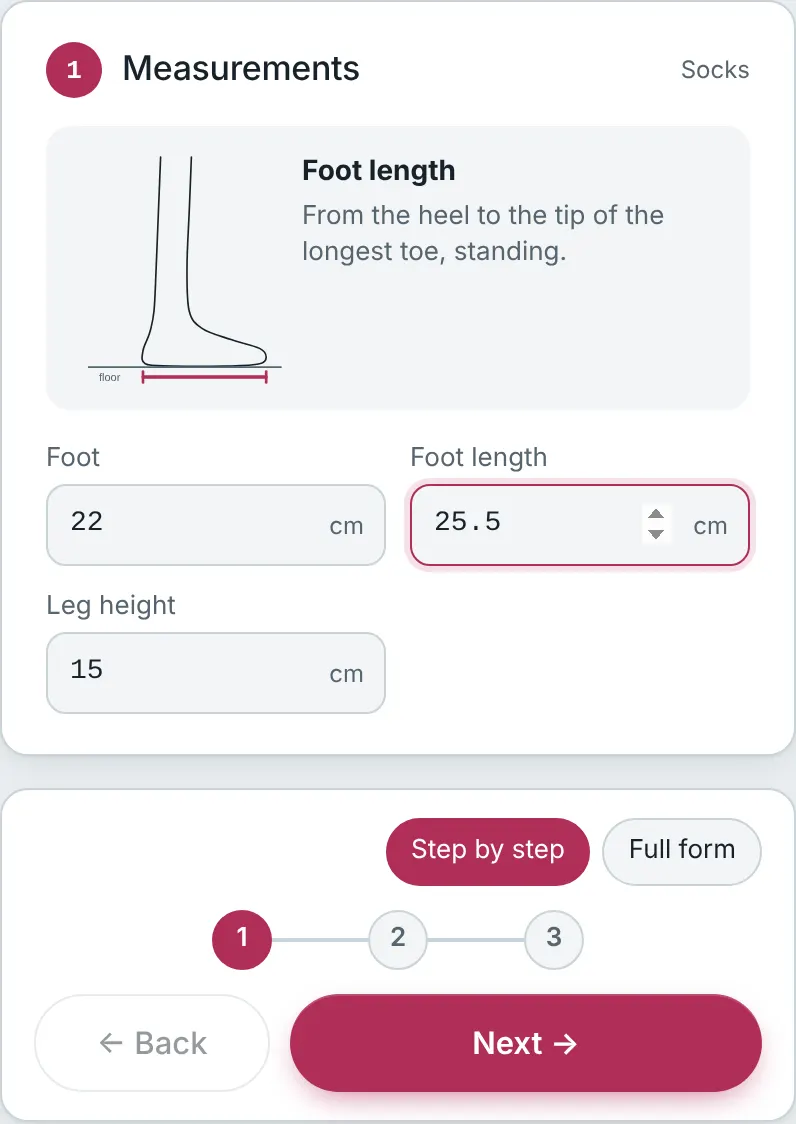
We follow one pair from measurements to the last stitch: foot circumference 22 cm (8.7 in), foot length 25.5 cm (10 in), merino 50 g / 125 m on 4 mm needles. Every number below is real output from the builder, and the screenshots show where to find it. Enter your own measurements and you get the same pattern for your foot.
What you need
- Measurements: foot circumference (widest part, around the ball of the foot), foot length (heel to the tip of the longest toe, standing) and the leg height you want — here 22 cm, 25.5 cm and 15 cm.
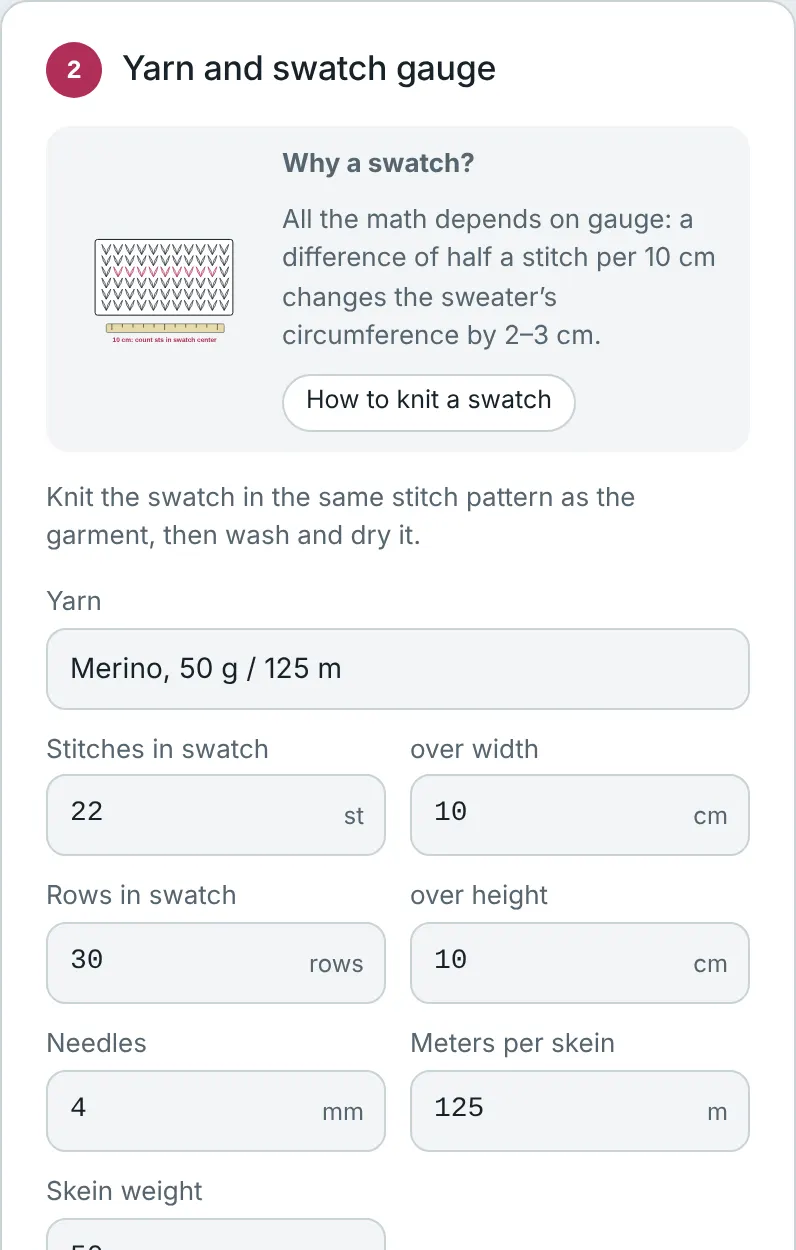
- Yarn: merino 50 g / 125 m. The builder estimates 210–270 m for the pair, so 2–3 balls.
- 4 mm needles: double-pointed or a long circular for magic loop.
- Gauge: 22 sts and 30 rows per 10 cm. If yours differs, just enter your numbers.
What the builder worked out
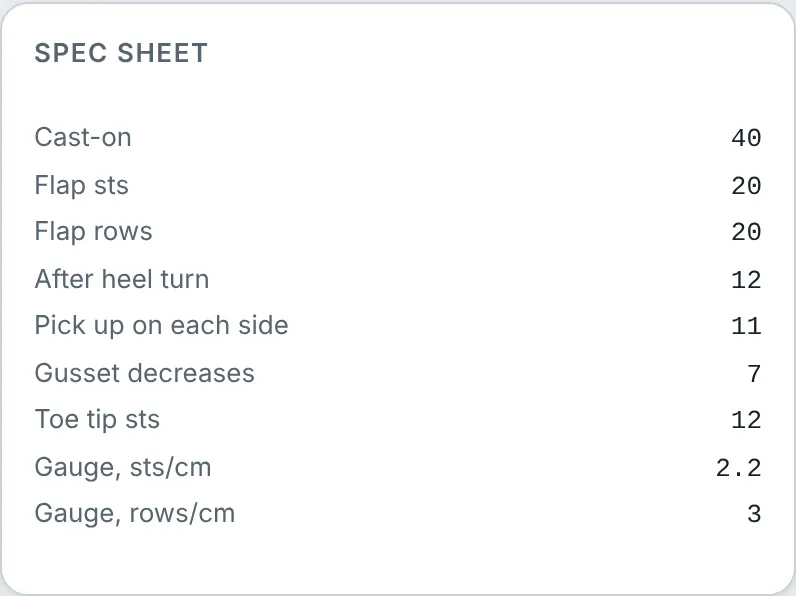
After “Create pattern” you get a spec sheet with the key numbers. For this foot: cast on 40 sts, heel flap over 20 sts for 20 rows, 12 sts left after the heel turn, pick up 11 sts along each side of the flap, 7 gusset decreases and 12 sts at the toe tip. The finished sock is 18.2 cm around with a 24.5 cm foot — a little smaller than the foot, so it fits snugly and doesn't bunch.
1. Cast-on, cuff and leg
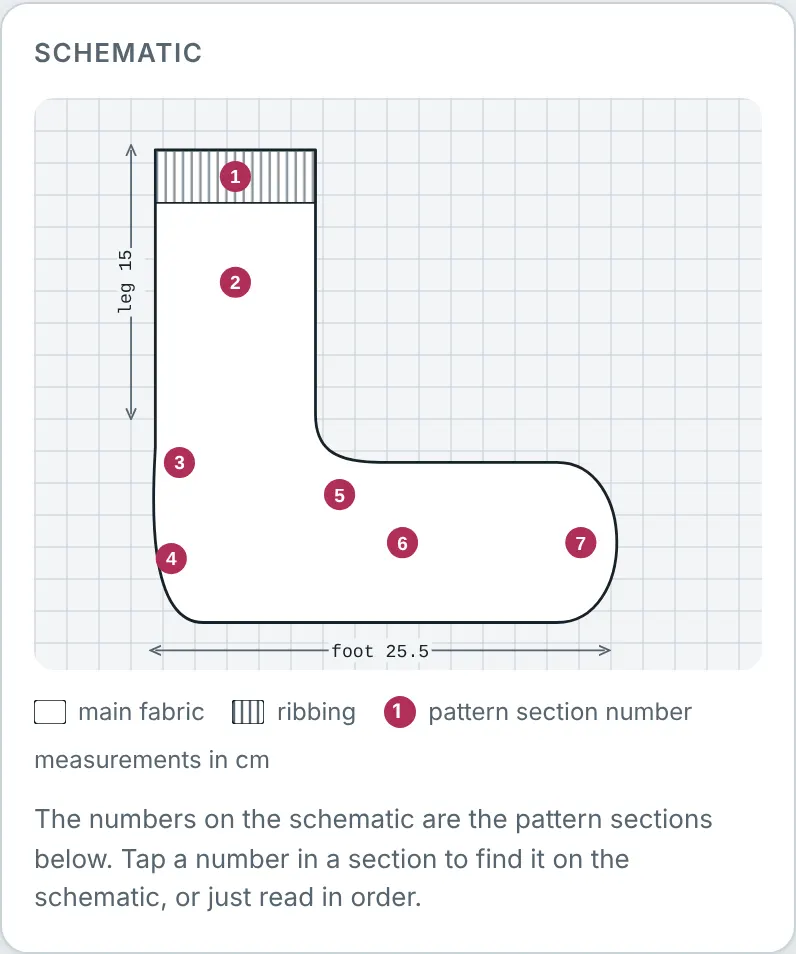
Loosely cast on 40 sts and join in the round without twisting. Work 2×2 rib for 9 rounds (≈ 3 cm). Then the leg: stockinette or the same rib for 36 rounds — about 15 cm from the cast-on. Cast on loosely so the cuff goes over the heel.
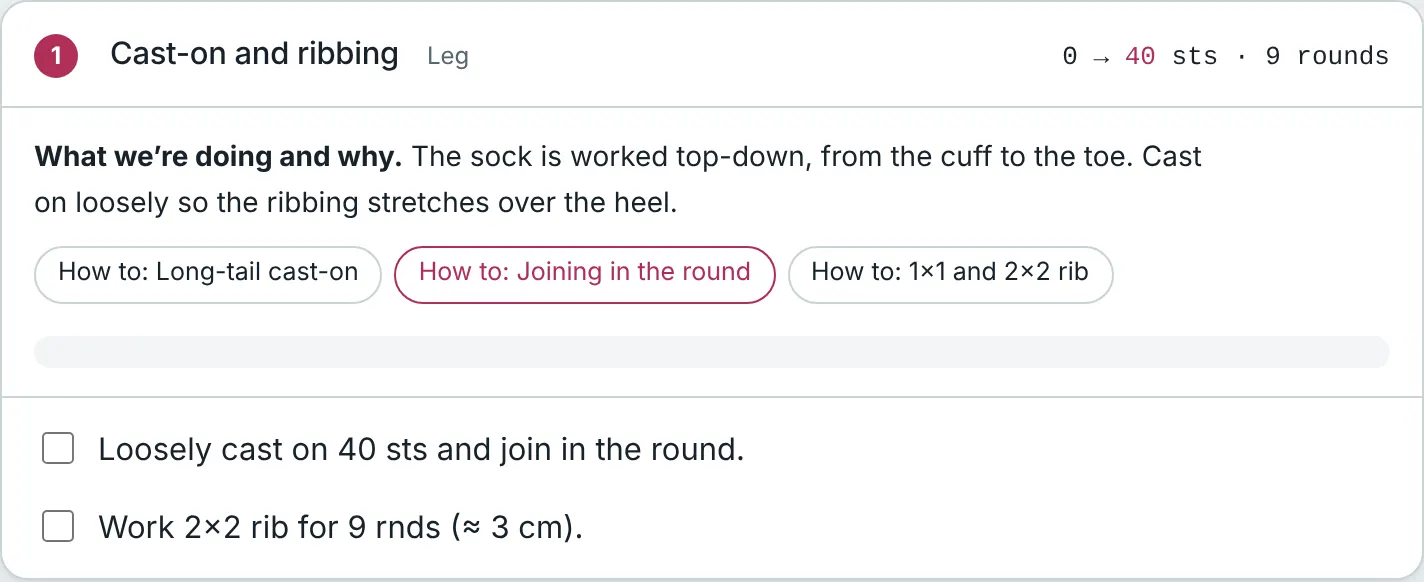
Lessons: long-tail cast-on, joining in the round, 2×2 rib.
2. Heel flap
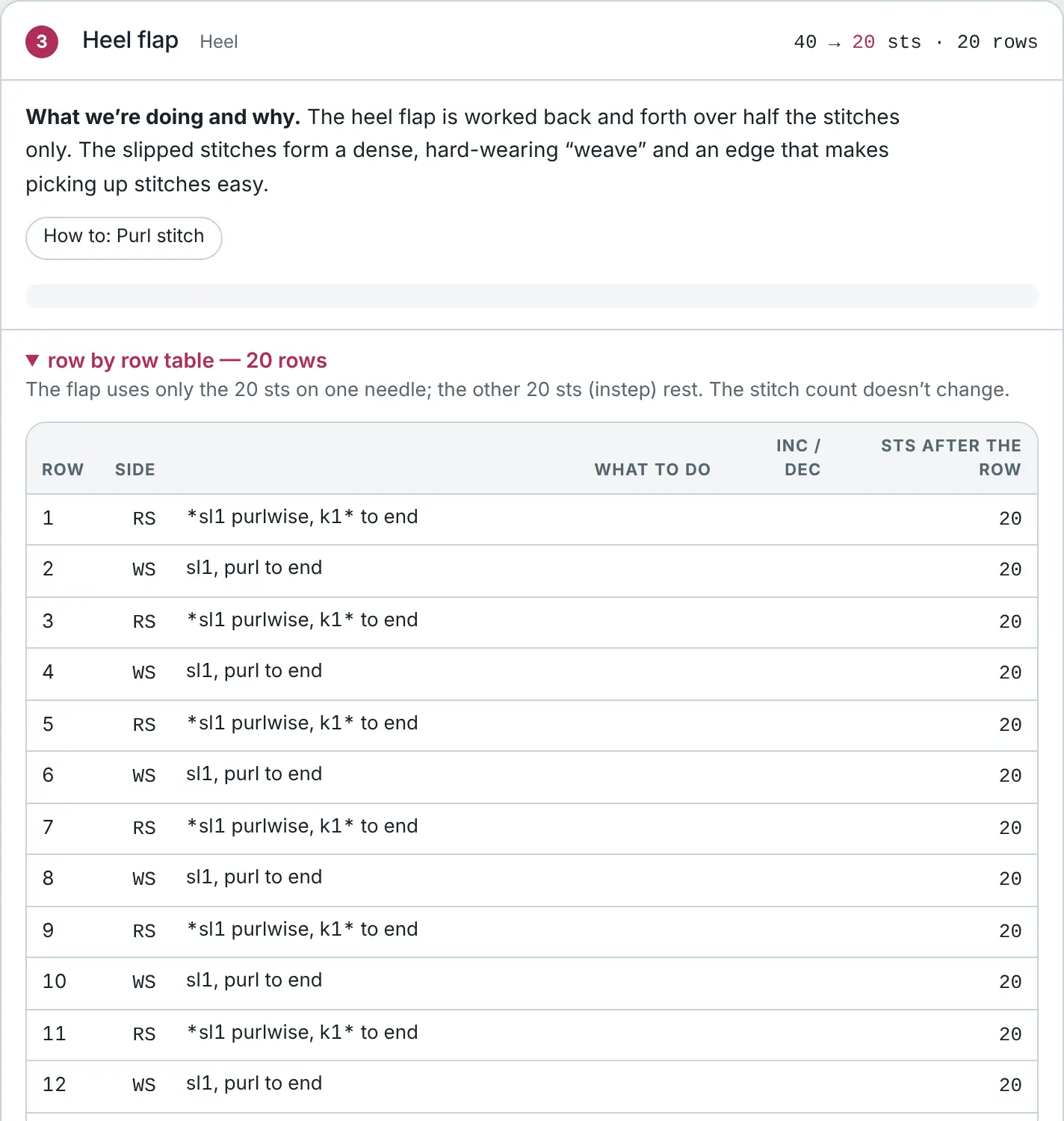
The flap is worked back and forth over 20 sts only; the other 20 sts (instep) rest. Row 1 (RS): *slip 1 purlwise, k1* to end. Row 2 (WS): slip 1, purl to end. Repeat for 20 rows (≈ 6.7 cm). The slipped stitches make the flap dense, so it doesn't wear through.
3. Turning the heel
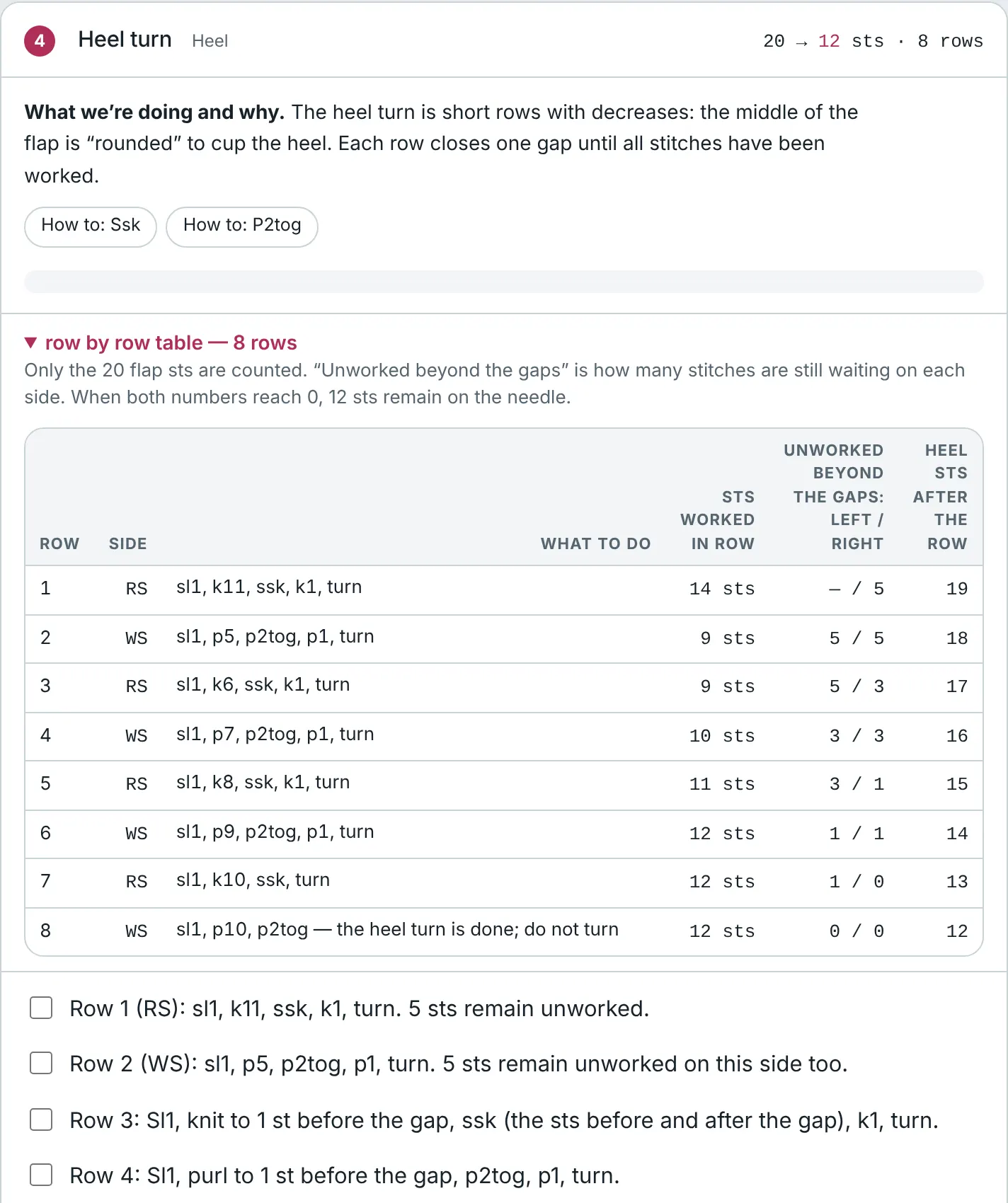
Short rows with decreases round off the heel: 8 rows, from 20 sts down to 12. The first two rows are “slip 1, k11, ssk, k1, turn” and “slip 1, p5, p2tog, p1, turn”. Each following row closes one gap. The builder's table shows how many stitches remain on each side after every row, so it's hard to lose your place.
4. Gusset
Back to knitting in the round: knit the 12 heel sts, pick up 11 sts along the flap, knit the 20 instep sts and pick up 11 more — 54 sts. Then alternate a decrease round (k2tog before the instep, ssk after it) with a plain round, 7 times, until you're back to 40 sts.
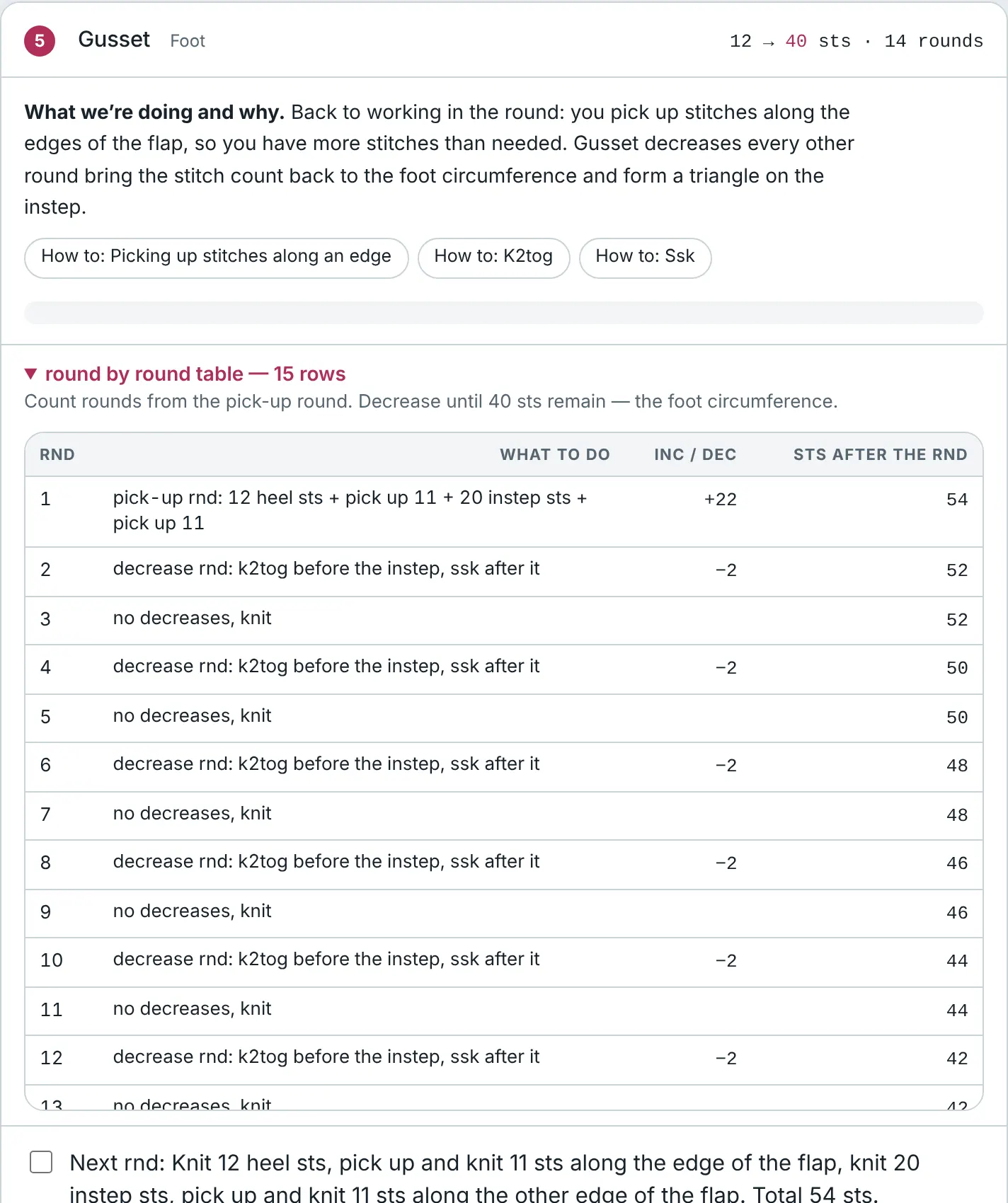
Lesson: picking up stitches along an edge.
5. Foot
Stockinette in the round until the foot measures 20.5 cm from the back of the heel, leaving 5 cm for the toe. Measure the sock on the foot rather than counting rounds — that's how the length comes out right.
6. Wedge toe and Kitchener stitch
Arrange the stitches: 20 sole sts and 20 instep sts. Decrease round (−4): *k1, ssk, knit to 3 sts before the marker, k2tog, k1* twice. First 10 rounds decreasing every other round (40 → 20 sts), then 2 rounds decreasing every round (20 → 12 sts). Graft the last 12 sts with Kitchener stitch (6 + 6). Make the second sock the same way.
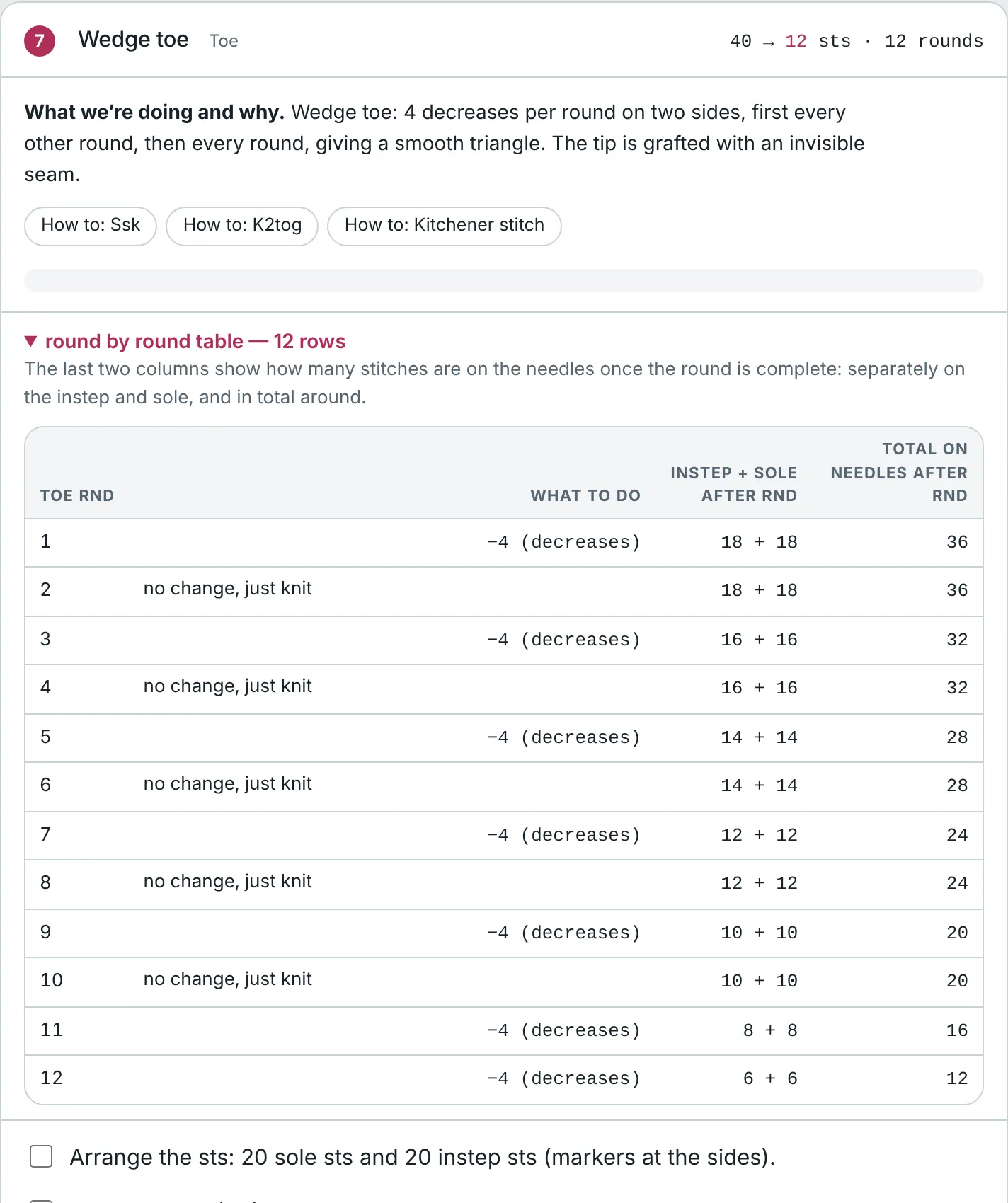
Lesson: Kitchener stitch.
The finished sock
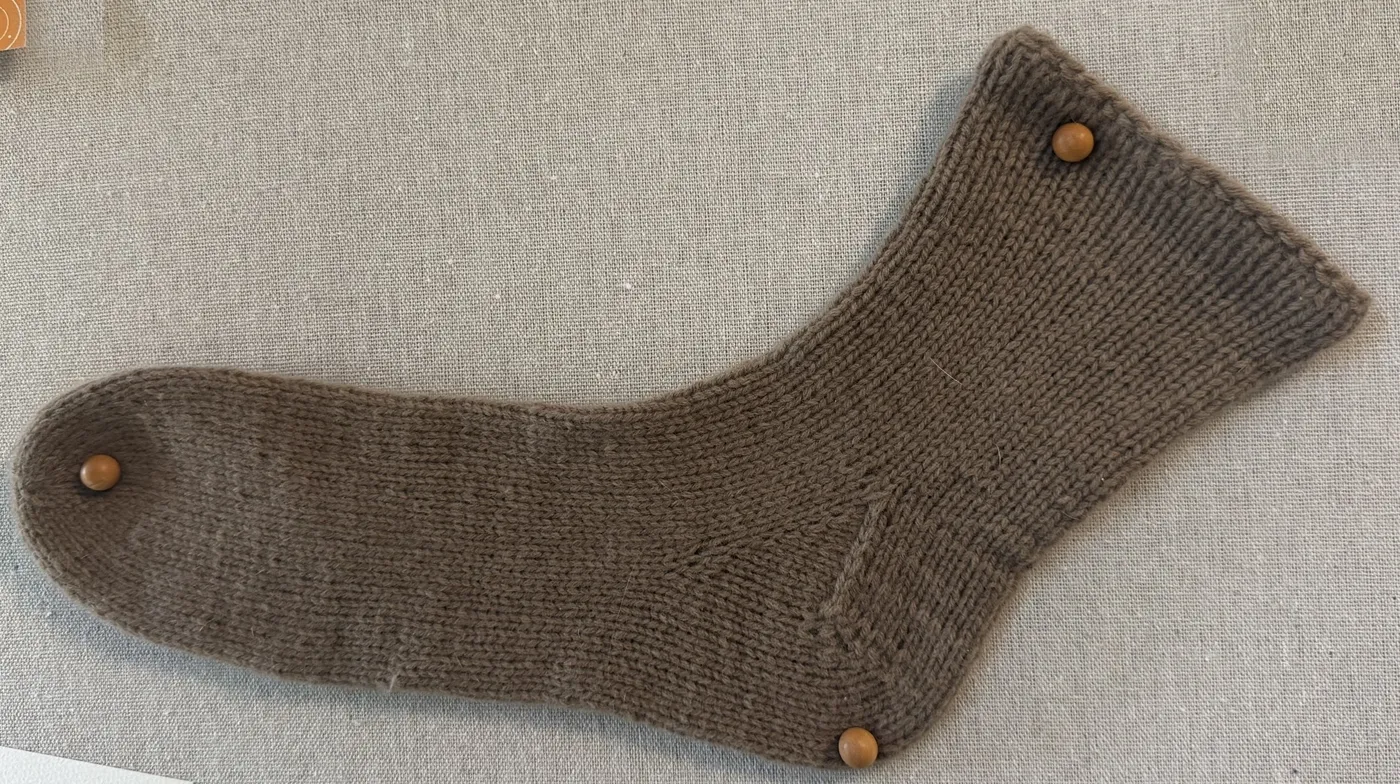
This is the sock knit from exactly these numbers: heel flap, gusset and wedge toe. It measures 18.2 cm around — a little less than the foot, so it hugs without bunching.
FAQ
How many stitches should I cast on for socks?
Foot circumference minus about 10 % so the sock hugs the foot, times your gauge, rounded to a multiple of 8 so the stitches divide evenly between sole, instep and gussets. For a 22 cm foot at 22 sts per 10 cm that’s 40 sts. In fingering-weight sock yarn the same foot needs 56–64 sts.
How much yarn do I need for a pair of socks?
For this pair the builder estimates 210–270 m of merino 50 g / 125 m. It depends on foot length, leg height and yarn weight — the calculator works it out for your measurements.
How do I get the foot length right?
Don’t count rounds — measure from the back of the heel. When the remaining length to the tip of the big toe equals the toe length (5 cm here), start the toe decreases.
Can I knit socks toe-up?
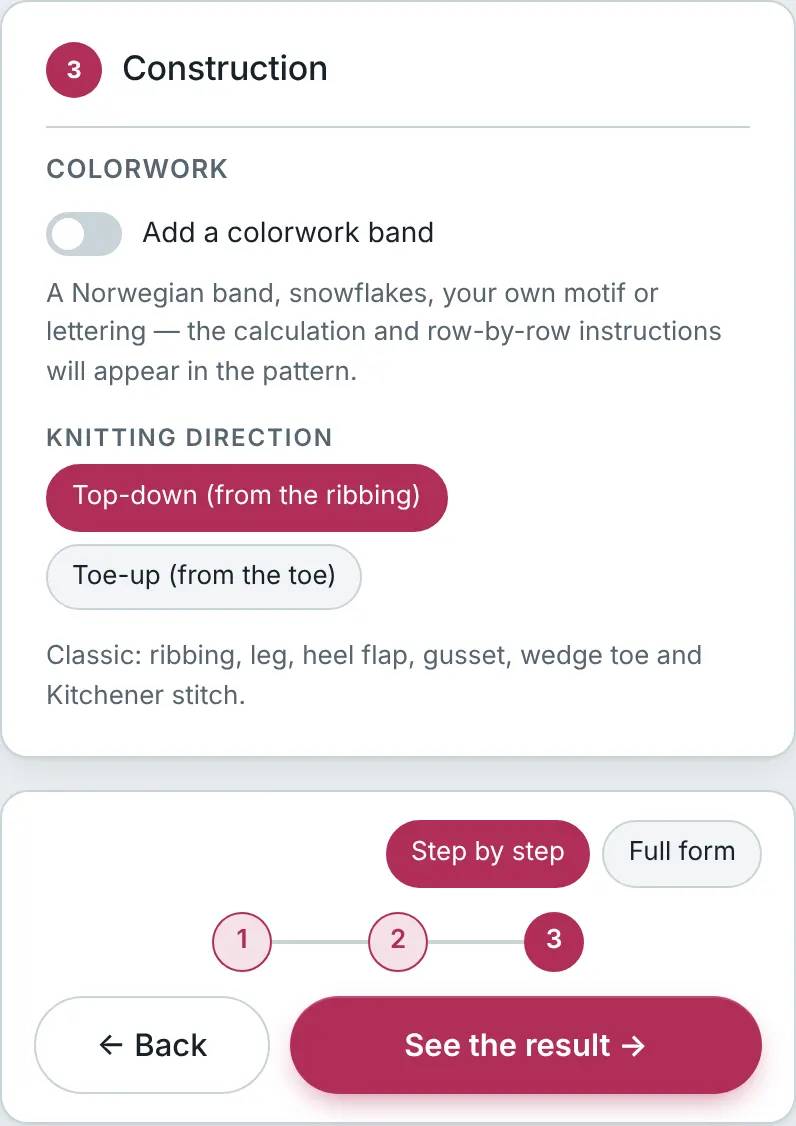
Yes, the builder has a “bottom up (from the toe)” option: Judy’s magic cast-on, toe increases, foot, heel and leg. Handy when yarn is short — you knit until it runs out.